Trend, Tradeshow Recaps, Industry Insights and more!
Brandon Warren
Raise your hand if you’ve heard this before, “Private label is only for price-sensitive shoppers.”
That era is over.
Store brands are no longer a discount side hustle; they’re the primary growth engine in U.S. retail.
Brands ignoring that shift are putting themselves in a position of weakness. Today, there’s a private label reckoning and smart brands who manufacture their own products are joining the house instead of fighting it.
The Numbers Don’t Lie
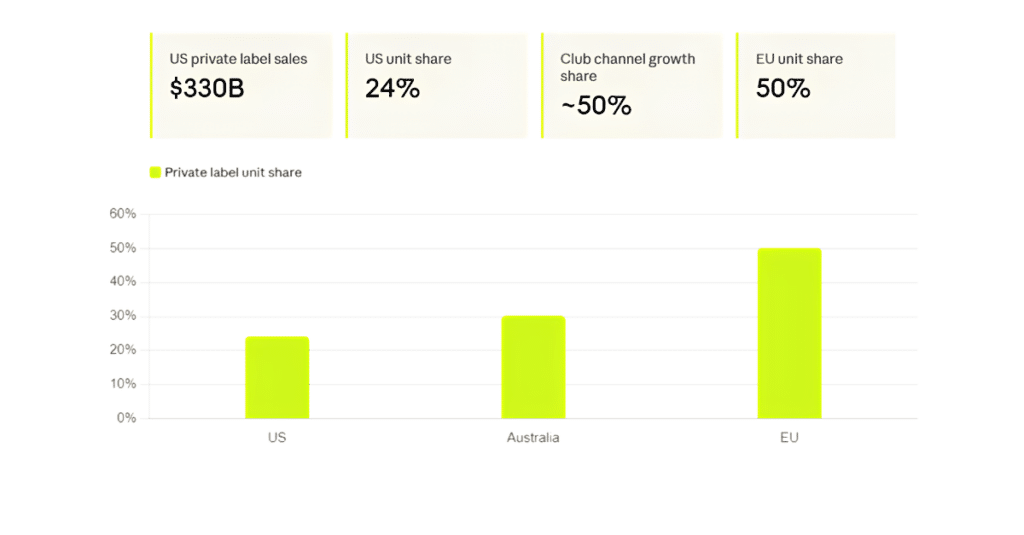
Private label brands aren’t just growing; they’re growing while national brands slow.
The majority of shoppers now say that private label products offer good value and 72% view them as strong alternatives to national brands.
This isn’t a recession coupon strategy, the majority of households earning above $100,000 say they’ve increased how often they purchase private label products. This is premium, permanent behavior change.
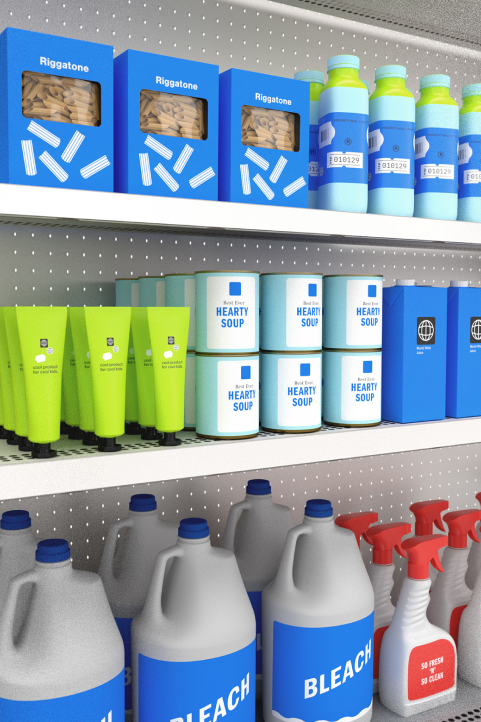
Younger and higher-income shoppers are driving broader acceptance of private labels and the generic-looking packaging of old has given way to modern, premium design.
Retailer-owned brands are increasingly winning on value, quality, health and sustainability, not just price.
How to Compete with Store Brands? Might be Time to Adjust the Sails
When brands are preparing to walk into a buyer meeting with a pitch addressing, “Why we’re different from the store brand,” I share this (often uncomfortable) truth. That’s not the question buyers are asking anymore. Retail buyers aren’t evaluating your brand story in isolation, they’re asking whether you can grow the entire category, including their own private label. And if you can generate digital demand on your own budget that outperforms their house brand head-to-head online.
That’s a whole different kettle of fish than most brands are prepared for. It means the old, often hostile position toward private label is increasingly a losing strategy.
Retailers with the fastest-growing store brands are actively building them into their supply chain.
When a buyer’s own private label is outgrowing national brands three-to-one, the brand that shows up trying to convince them their house line is bad for business isn’t going to get much airtime.
The smarter play?
A co-development strategy. Help build the private label instead of fighting it. Some of the most sophisticated national brands are already doing this.
While the majority of these deals are undisclosed (confidentiality is a feature, not a bug), excellent examples include Costco’s co-branded Kirkland lines with Starbucks for coffee and Hormel for bacon.
Partnering directly with retailers to co-develop store lines can lead to guaranteed shelf stability and being stickier with the retailer. It also elevates brands to being a more important part of the overall category strategy.
The Manufacturing Play
If your operation has manufacturing headroom, that excess capacity becomes leverage rather than a liability. The Barcode Group regularly advises brands to use idle production runs to supply a retailer’s house brand with proven, legacy formulations: recipes that are stable, cost-effective and already de-risked. Meanwhile, your newest, highest-margin innovation stays exclusively in your own name-brand packaging, protected from private-label commoditization and positioned as the reason shoppers still seek out your name specifically.
This isn’t giving away the farm; it’s monetizing capacity you’re already paying for while cementing a supply relationship that makes you difficult to replace.
A retailer that depends on your production line for their own private label has a strong incentive to keep your branded products on shelf, prioritized and well-positioned. Pulling your line would hurt their own house brand too.
At the End of the Day
Private label isn’t a threat to be defeated. Now it’s a retail growth strategy and buyers have made that clear in how they now evaluate every pitch. Brands fighting that reality are negotiating for shrinking shelf space. Brands that are manufacturing their own products and find a way to become part of the private label supply chain while protecting their own innovation pipeline are negotiating for guaranteed stability, category influence and a seat at the table for the next decade of retail growth.
Wondering what this could look like for your brand? Let’s grab time and talk it through. We can talk about your capacity, your formulas, your shelf… that’s my favorite kind of conversation. Book some time here.

We’re constantly gaining industry knowledge: from tips and tricks to back end data, we got crazy amounts of knowledge ready to share with you.
Get access